
Endorsed Safety Valves and Gauges at Marintec China 2025

Managing a cargo ship, workboat, or an offshore oil and gas site brings its own set of challenges. You must keep people safe, protect your equipment, and the environment. Not to mention, you must bear in mind all the regulatory changes that take place.  

You need clear, reliable readings of the liquids inside your tanks. As well as robust pressure safety management via safety valves. However, if your liquid level gauges or safety valves fail, you face expensive stops to your workflow and cause serious safety risks across your site.

Imagine the worry of not knowing the exact liquid level in a tank; it could cause issues for your team. Not enough fuel in the tank could leave them stranded. Not enough water in the tank for your crew’s journey… well.

What about a valve not opening when pressure builds up in a system on your ship or rig? That uncertainty leaves you feeling exposed and vulnerable to failure, and puts lives at risk. That’s why we attended Marintec China. These are the sort of challenges we specialise in solving, and we aim to help you find the right liquid level gauge or safety valve for your needs.

At Marintec China 2025, we spoke with project engineers, directors and fellow business associates about our products that lessen those worries. We give you a clear, easy ways to manage safety and measurement across your ships and offshore platforms, letting you focus on your project goals.

Connecting with the Maritime Industry at Marintec China 2025

The shipping and offshore industry is constantly changing. This is especially true as we direct more of our focus towards greener fuel solutions for the planet, such as hydrogen. Which is why you need equipment that can handle these new demands on both your ships and your platforms. That way, you ensure you’re doing the best for your people, business and environment.

So, what did we get up to at Marintec China 2025?

Our representative, Larita Prescott, met with engineers and decision-makers in the maritime industry from around the world. We listened to the challenges you face in today’s marine environment. Such as meeting new energy, safety, and efficiency standards. We shared how our UK-manufactured, certified liquid level gauges and safety valves can help. It was a pleasure talking with everyone who stopped by and with fellow businesses in the marine industry.

Image features SEETRU brand products, including liquid level gauges, safety valves, threaded valves, flanged valves and change-over valves for use with hydrogen. All in a trade show setting at Marintec China 2025 with professionals discussing details.

Talk to Us About Liquid Level Gauges

Knowing the liquid level inside your oil tank or water tank must be something you can do easily. You need a reliable liquid level gauge to ensure your systems are safe and your tanks have the right liquid levels. We have perfected this with two leading products for the shipping and offshore industry, which we had the pleasure of discussing at Marintec China 2025.

The G31 Seeflex Liquid Level Gauge

The G31 Seeflex liquid level gauge gives your team a direct, easy view of the liquid level in your tank. It has a robust, mild stainless-steel build, toughened borosilicate reflex glass and comes with push-button spring-loaded valves. The spring-loaded valves isolates the contents of your tank till your crew goes to check the levels. This gauge helps you get clear readings of your levels, minimise leaks, and is SOLAS compliant. Your certified and proven solution in demanding environments.

The G35 Seemag Magnetic Liquid Level Gauge

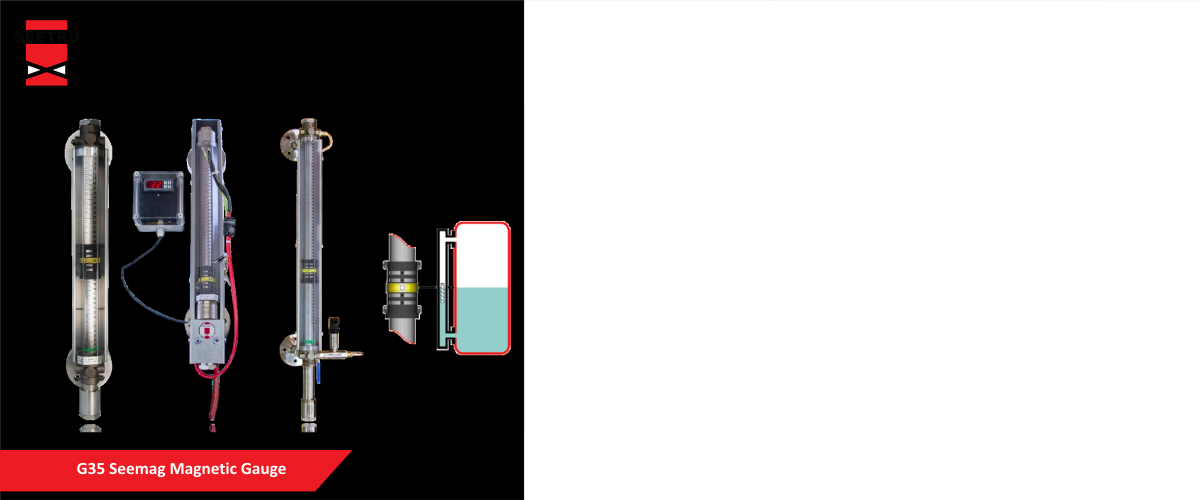
Our high-quality yet economical magnetic liquid level indicator for all-round visibility liquid level checks. The G35 uses magnetic technology to give a clear reading without touching the liquid itself. It keeps your team and site secure. It also has the option of high/low-level alarms with remote digital reading. Yet another robust liquid level gauge that is SOLAS compliant and proven in a range of harsh environments.

Your team, business and environment are our priority. Which is why we engineer high-quality and easy-to-maintain liquid level gauges that go through strict tests and gain a range of approvals. Making them applicable for use in different industries and regions across the world.
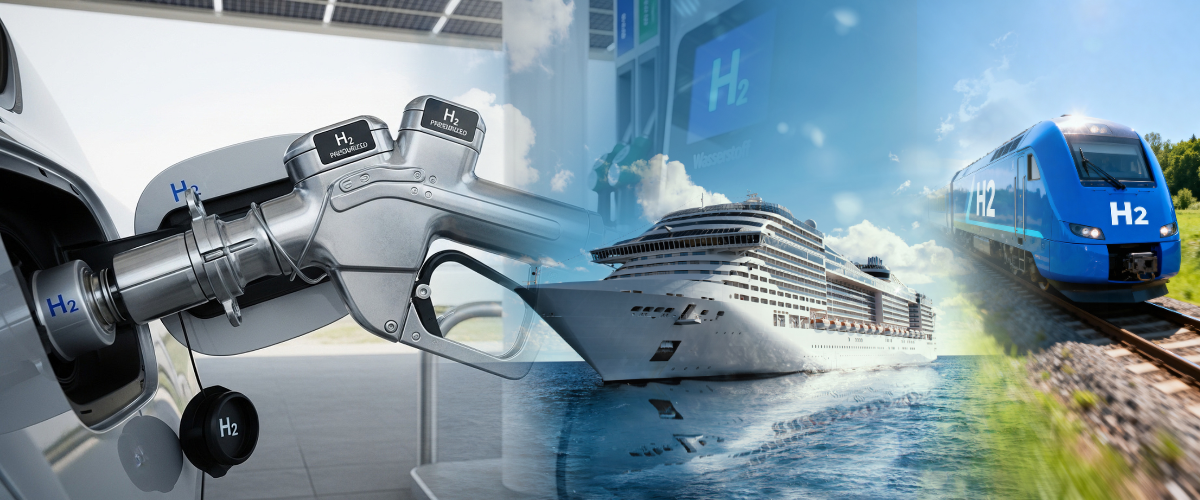
Hydrogen fueling systems for vehicles, ships, and trains, showcasing the versatility of hydrogen as a clean energy source.

Safety Valves for Current and Future Challenges

As ships and offshore rigs adopt new fuels and face new regulations. Safety valves must be able to deal with these new challenges. As well as go through rigorous tests to pass the new regulations to ensure their suitability and performance for these challenges.

Project engineers, decision makers, managers and those further afield. Had the opportunity to learn and share their knowledge on these greener fuels, and the challenges they bring at Marintec China 2025. We also had the opportunity to share how our hydrogen safety valves are built to tackle the challenges greener fuels like hydrogen bring. Your team relies on their environment, your site, to have reliable protection against pressure build-up, both with standard and with emerging fuel systems.

You, I… we’re all aware of the progress the hydrogen industry is making. We’re seeing hydrogen-powered cars like the Mercedes-Benz GLC F-Cell, which uses combined hydrogen consumption, hydrogen-powered trains in California, and liquid hydrogen-powered ferries like the MF Hydra.

We also have Fincantieri and Viking’s announcement from April 2025, of the first cruise ship in the world that will be powered by hydrogen stored onboard the ship. That hydrogen will be used for both propulsion and onboard electricity. Hydrogen is becoming such a big part of so many different industries as a green solution to be used for the well-being of our environment. That’s why we have developed safety valves that aren’t just capable of dealing with industries like oil and gas, refrigeration, chemical, etc, but safety valves that are built for the future.

A technician maintaining MEP hydrogen electrolyser stack at an industrial facility.

Seetru Hydrogen Safety Valves 

We offer a selection of safety valves built to handle the demands of hydrogen and other new fuels, helping you meet future safety standards. Below we’ll go over some of our selection.

Seetru’s Change-over Valves

These valves allow you to switch between two relief valves without needing to turn your whole system off. This means you can keep work going and your team safe, while maintenance or valve replacement is being done. Having this level of flexibility is key for any industry, as well as for offshore platforms and the marine industry in general. We are proud to have had the opportunity to share more about our change-over valve selection at Marintec China.

Discover our selection of change-over valves here.

Seetru’s Flanged Valves

For larger industrial systems or sites that require high flow capacity, our safety valves with flanged connections offer easy installation and removal without complicated piping adjustments. The flanged connection means securing the valve is straightforward and ensures a strong, long-lasting seal. Saving your team time during installation and maintenance.

Seetru’s Safety Relief Valves

Beyond our change-over valves and flanged valves. We also offer a range of compact safety valves well suited to the hydrogen industry supply chain. Including Type 646/641, Type 946H5/956H5 and Type 946 threaded. These are just a few mentions from a selection of safety valves that are designed to deal with the demanding pressures and conditions found across the hydrogen supply chain, from hydrogen production and storage through to dispensing and transport.​

  • Built for hydrogen conditions 
    Materials like the stainless steel 316 and our valve designs are chosen to help resist hydrogen embrittlement and minimise the potential of cracks in the valve that would cause leakage.
  • Compact and space‑saving
    Valves such as the  946H5/956H5 are compact, so they fit easily into small skid units, dispensers and compressor systems without the need for major layout changes.
  • Consistent workflow 
    Our advanced sealing technology and simple internal mechanisms are designed for optimal and repeatable opening and tight reseating of the valve. This is to minimise the possibility of leaks, which would bring your work to a halt.
  • Flexible connection options 
    Threaded versions like the Type 946  let you screw the valve directly into existing threaded connections on pipework or small pre‑assembled units. This makes installation quicker and simpler, especially in tight spaces or where adding flanged connections is not practical.
  • Support across the hydrogen supply chain 
    With Seetru, you can use one supplier for safety valves at every stage of your hydrogen projects, including production, compression, storage, transport and fuelling.

You can discover more about our available safety valves for the hydrogen industry here.

A collage of images showcasing urban transit, water treatment, food production, safety measures, and industrial processes.

We also have a wider range of valves to cover other industries, such as:

  • Rail industry
  • Chemical industry
  • Oil and gas industry
  • Compressed air and gas industry
  • And more…
  • Cryogenic and liquefied gas
  • Fire safety industry
  • Water and steam
  • Food and beverage industry

Ready to discuss your next project?

If you didn’t get the opportunity to catch up with our representative, Larita Prescott, at Marintec China, but are interested in our products for your next projects and goals. We’d be happy to support you. Please get in touch with our sales team either via our contact form, email or telephone number, which can be found on our contact page.


FAQ section for Marintec China 2025

Where can I see which exhibitions Seetru will be attending?

You can find our latest list of trade shows and events on our dedicated Trade Shows and Events page. This page is updated as new exhibitions are confirmed, so it’s the best place to see where you can meet us in person. We also have past exhibitions listed, so you get an idea of where we will be in the years to come.

Where can I find product approvals and certificates for Seetru valves and gauges?

If you need a specific approval for a project. Approvals for many of our products and the company are available to view on the Approvals page. You can also contact our sales team, who will be happy to provide you with information and products with the approvals and documentation you need.

Can you help me choose suitable products for a specific vessel or offshore project?

Yes, if you share details such as the application, temperatures, pressures, media (such as type of liquid, gas, etc), operating conditions and any class or regulatory requirements. Our team can recommend suitable liquid level gauges and safety valves. The easiest way to do this is via the form or contact details on our contact page.

The certifications ensure our valves meet high global safety, quality, and regulatory standards for the hydrogen industry. From hydrogen production, to storage, transport, fuel cells, and even use with liquid hydrogen. We have valves suitable for every part of the hydrogen supply chain.

How Kormarine 2025 Provided You with Better Maritime Safety

Kormarine 2025 brought together people from across the marine and offshore industries. From shipbuilders and engineers to equipment suppliers and technical teams. Everyone came with a clear goal in mind. To keep their teams, business, and environment safe at sea and on offshore sites.

This year, we were part of the UK Pavilion in Busan, South Korea. Kormarine 2025 gave us the opportunity to speak with visitors who wanted liquid level gauges that gave them a clear reading of the liquids in their tank, safe pressure control, and equipment they can depend on during daily work and audits.

Today, we’ll look at what we shared at Kormarine 2025 and how our liquid level gauges and safety valves support safety on board vessels and offshore platforms.

What we shared at Kormarine

At this year’s Kormarine event, we spoke about our G35 Seemag® Magnetic liquid level gauge, known for its robust design, featuring a polycarbonate front guard, an aluminum alloy rear guard, and additional components constructed from stainless steel 316. The level indicator and follower are made from polypropylene and nylon materials. All these components are what make the G35’s performance so reliable, even in harsh marine environments. This gauge provides clear, easy-to-read tank level indications, and its clear-cut design keeps maintenance simple for your crew.

We also took the opportunity to present our hydrogen safety valves, which attracted attention due to the industry’s move toward clean energy such as hydrogen. These valves are designed for safety, leak-tight performance, and media compatibility throughout the hydrogen supply chain. Supporting the growing interest and investment in cleaner fuel for the marine industry.

Image of the G35 Seemag Magnetic liquid level gauge with a digital display and diagram, alongside an offshore oil platform and shipping vessel on the water.

Support for builders & engineers after Kormarine 2025

Kormarine 2025 showed how much care goes into each vessel and offshore site.

Shipbuilders, engineers, and crew work under daily pressure to protect people’s lives, prevent costly leaks, and ensure they have everything they need to pass audits with ease.

We understand these challenges and aim to help you remove uncertainty. That’s why our products deliver on:

  • Clear tank visibility:
    Your teams will know their liquid levels at a glance.
  • Safe pressure control:
    Preventing dangerous overpressure blasts or failures.
  • Audit-ready documentation:
    Keeps proof of compliance simple and stress-free.
  • Expert advice whenever you need it:
    Making product selection straightforward and hassle-free.

With our safety valves and liquid level gauges, builders, crew members, and engineers can focus on building safer ships and offshore installations that stand the test of time.

How to reach us after Kormarine 2025

Whether you connected with us at Kormarine 2025 or missed the event but want to learn more about how we can support you on your next project. We’re here to help you find the right maritime safety equipment for your system.

If you require advice on choosing a liquid level gauge or safety valve for your vessel or offshore rig, feel free to reach out to us today.

You can contact our team by email, phone, or through the form on our contact us page. We’re ready to support your next project with certified and proven safety valves and liquid level gauges.

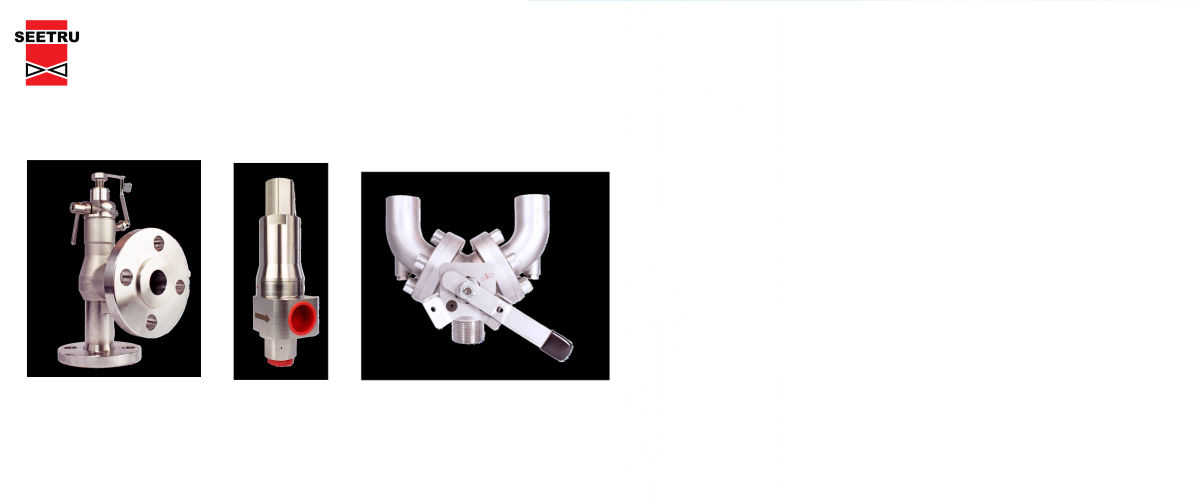
Three Seetru hydrogen safety valves displayed beside a cargo ship on the ocean, showcasing a selection of valve types discussed at Kormarine 2025 for the marine industry.

Final thoughts…

Kormarine 2025 gave you better maritime safety by giving you the opportunity to connect with businesses from across the world. Businesses like ours that have spent decades developing and engineering products to keep your team, business, and environment safe. Some of you even took the chance to meet our Seetru representative at the UK pavilion, supported by one of our South Korean distributors.

At Kormarine 2025, you learned more about our G35 Seemag® Magnetic Liquid Level Gauge and hydrogen safety valves. The G35 gauge helps crews check liquid levels in their tanks quickly, even in the harshest environments. While our valves keep your equipment and people protected from harm overpressure can cause. Our approvals attached to our liquid level gauges and safety valves are proof of how serious we are about people’s lives. We also provide you with audit-ready paperwork, so you avoid fines and delays. 

Shipbuilders, project engineers, and decision makers like yourself, left Kormarine knowing they have reliable options for the demands of their industry in the marine environment.


FAQ section for Kormarine 2025

What makes the G35 Seemag Magnetic liquid level gauge suitable for the maritime industry?

Our G35 Seemag® Magnetic liquid level gauge handles salt air, vibrations, and rough seas very well due to its robust build. Its polycarbonate front guard and stainless steel 316 parts protect against corrosion and impacts common on ships.

The polypropylene and nylon indicator gives clear tank readings for diesel, fuel oil, chemicals, and other liquids up to 40mm²/s viscosity (liquid thickness). Rated for 18 bar pressure and 180°C in marine use, it meets SOLAS requirements for use with flammable liquids on vessels. Additionally, no glass use means minimal shatter risk if knocked, keeping crews safe during rough weather.

Can I get product support locally in South Korea after Kormarine 2025?

After Kormarine 2025, the largest marine industry event in South Korea has come to an end. You’ll still be able to get local support from Seetru’s official distributors. You can find out more via our distributors page. There you will be able to select your continent and country to discover distributors local to you.

What safety standards do Seetru hydrogen valves comply with?

Our hydrogen safety valves comply with multiple safety standards and certifications, including:
• BS EN ISO-4126-1 & -7 design codes
• PED 2014/68/EU (CE marking)
• PE(S)R UK SI 2016 No. 1105 (UKCA marking)
• ASME BPVC VIII.1 & XIII (with UV stamp)
• TÜV type test approvals
• National Board approval
• CRN certification
• EAC (TR CU) customs union certification

Core standards (BS EN ISO-4126, PED/CE, UKCA) apply across the range. Additional approvals like TÜV, CRN and ASME vary by model. Please make sure to check individual datasheets for your specific valve needs. You can discover our full hydrogen valve range on our hydrogen industry page.

The certifications ensure our valves meet high global safety, quality, and regulatory standards for the hydrogen industry. From hydrogen production, to storage, transport, fuel cells, and even use with liquid hydrogen. We have valves suitable for every part of the hydrogen supply chain.
When Do Liquid Level Gauges Need to Be SOLAS Compliant

Even the smallest component on a marine vessel can cause inspection failure. For example, if your liquid level gauge isn’t SOLAS compliant where it should be, the result can be project delays, extra costs, and questions over your crew’s safety.

The point of this article is to show you when SOLAS compliancy is required for liquid level gauges, what the standards mean in practice, and which Seetru gauges carry the approvals you need as a shipbuilder or engineer.

What is SOLAS?

SOLAS stands for the International Convention for the Safety of Life at Sea. It’s the main set of international rules that keep ships, crews, and passengers safe. The convention is managed by the International Maritime Organization (IMO), which is part of the United Nations.

The first version of SOLAS was first adopted in 1914 as a direct response to the Titanic disaster in 1912. However, it didn’t come into force in 1915 as originally planned due to the First World War.

An illustrated depiction of the Titanic sailing at night, surrounded by stars and an iceberg, with smoke billowing from its stacks.

Subsequent versions were adopted in 1929 (entered into force in 1933), 1948 (entered into force in 1965), and 1960 (entered into force in 1965). The current version in use is the SOLAS Convention of 1974, which was adopted on 1 November 1974 and came into force on 25 May 1980 after ratification by enough countries. This 1974 convention introduced a new amendment procedure that allows for faster updates to the rules.

Since the 1980s, the rules have been updated many times to cover modern shipping risks. Today, SOLAS covers almost every area of ship safety, from fire protection and lifeboats to structural design and, of course, equipment like liquid level gauges.

Why should this be important to you? If you’re building or running a ship, SOLAS is a legal requirement, and inspectors can check your gauges and other components during surveys. If a gauge should be SOLAS compliant and isn’t, the ship can be held back until the issue is fixed. That means time lost, additional cost, and possible reputational damage.

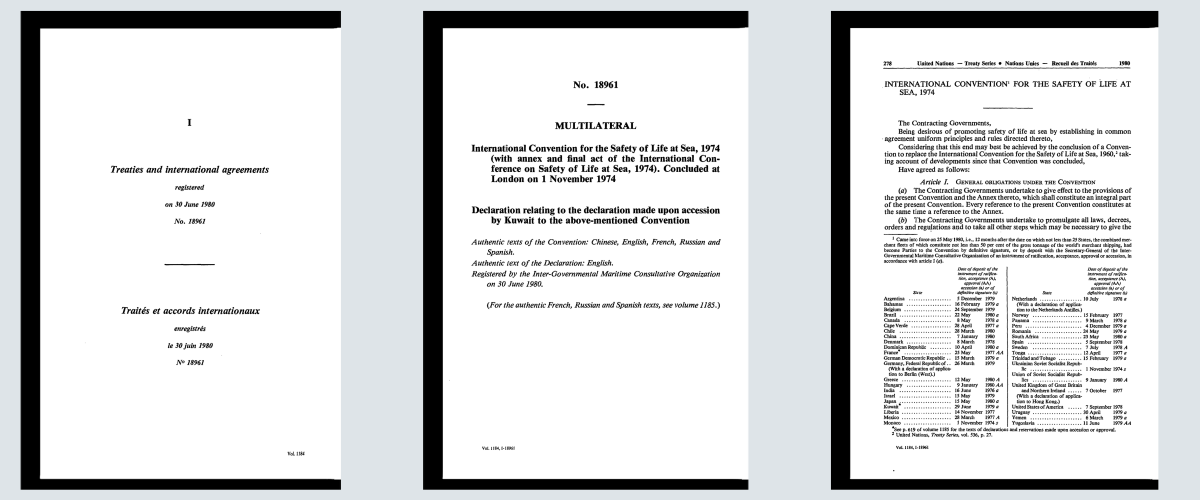
Treaties and international agreements - International Convention for the Safety of Life at Sea, 1974 .

Why do some Liquid Level Gauges Need to be SOLAS Compliant?

It really depends on the type of liquid the gauge is measuring and the safety risks involved. Which is why not all liquid level gauges on board a ship require to be SOLAS compliant.

If a gauge is used on tanks carrying flammable or hazardous liquids, like fuel or certain chemicals, it must adhere to SOLAS rules. These gauges need to meet tough international safety standards to make sure they won’t cause sparks or leaks that could lead to fires or explosions. They also have to be robust and reliable because a wrong reading could spell disaster for the vessel and crew.

That’s why gauges like Seetru’s G35 Seemag magnetic gauge or the G31 Seeflex reflex gauge come with multiple approvals from major classification societies. Making them SOLAS compliant. They’re designed specifically for those important high-risk applications.

On the other hand, gauges that measure less risky liquids or are used in different industries might not need to be SOLAS compliant.

For example, Seetru’s G21 Tubular Marine Gauge is a heavy duty liquid level gauge for marine and offshore industries. As it has a tubular design, this gauge is suitable for use with non-flammable liquids only. Therefore, it doesn’t need to be SOLAS compliant. It’s a liquid level gauge that is commonly used for water storage and coolant tanks on cargo ships, tugs and military ships.

Documented requirements focused on meeting SOLAS compliance for maritime safety and operational effectiveness.

What Does SOLAS Require from You and Your Liquid Level Gauges?

As previously covered, the International Convention for the Safety of Life at Sea requires that gauges on tanks holding flammable liquids, like fuel or hydraulic oils. Must be designed to prevent any risk of fire, explosion, or leaking dangerous substances. These gauges undergo rigorous tests to make sure they can operate well under harsh conditions. These tests cover pressure, wide temperature ranges, and exposure to vibration and rough seas.

The gauge’s construction is also checked to confirm it won’t fail or give false readings. That’s done because inaccurate level information could lead to overfilling, leaks, or unsafe operating conditions. Features like self-closing valves, sealed electrical parts, and robust mechanical design are essential requirements.

Additionally, SOLAS rules often require that gauges can be maintained or replaced in a safe manner while tanks are in service, without the risk of releasing cargo or fuel. Some gauges must also meet standards for explosion-proof electrical equipment (such as IEC 60079-series which covers safety requirements for electrical devices used in explosive atmospheres), depending on their design and location on the vessel.

Type approvals for gauges come from classification organisations like Lloyd’s Register, DNV, ABS, and Nippon Kaiji Kyokai (Class NK). They witness testing, review documentation, and certify compliance before issuing certificates.

This thorough approval process ensures that when a liquid level gauge is certified as SOLAS compliant (or carries the Wheelmark), shipbuilders and operators can trust its build quality, reliability, and reading accuracy. This commitment is essential for avoiding inspection failures, delays, or safety incidents at sea.

Seetru’s G31 Seeflex and G35 Seemag gauges are examples that satisfy these stringent SOLAS requirements and hold multiple type approvals, making them trusted choices for marine applications involving fuels and other hazardous liquids.

You can find more about our liquid level gauge approvals here.

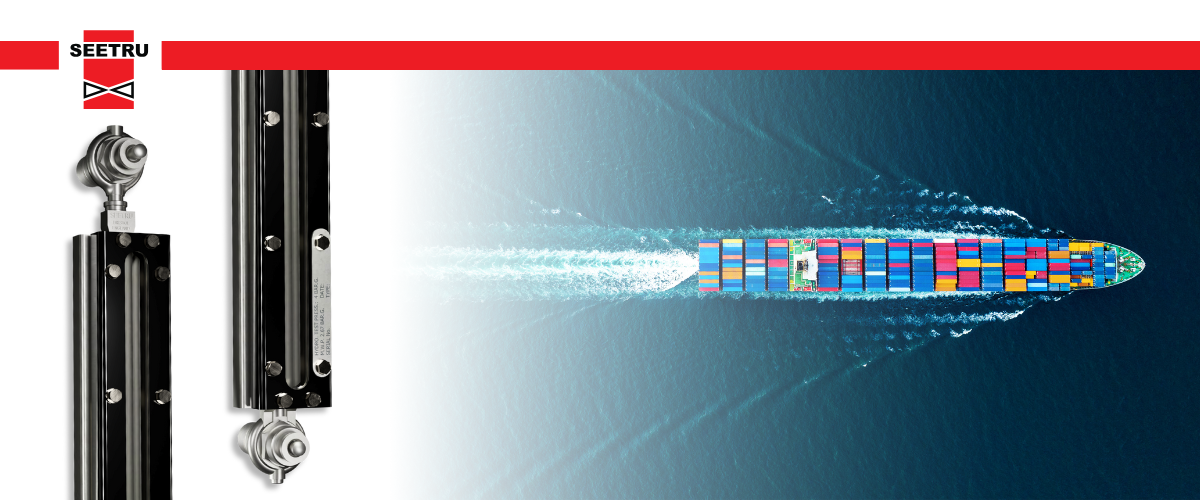
A shipping vessel heavily loaded with colourful containers sails through blue waters, alongside SEETRU’s G31 liquid level gauge.

How Do You Know if Your Liquid Level Gauge is SOLAS Compliant?

The simplest way to check if your liquid level gauge is SOLAS compliant is to look for the type approval certificates issued by recognised classification organisations, like the ones mentioned earlier on. They are independent organisations that test and certify gauges to meet SOLAS safety standards.

Manufacturers like us usually provide copies of these certificates along with the product documentation or list their approved gauges on their websites.

For example, our G31 Seeflex and G35 Seemag gauges are widely recognised with SOLAS type approvals and certifications from multiple organisations. You can also look for marks or labels on the gauge itself indicating compliance. These may include certification symbols or serial numbers traceable to a testing report.

Lastly, when you’re looking to buy a liquid level gauge, always ask your supplier for proof of said certifications that prove the gauge is SOLAS compliant. This is especially important if you will be using the gauge on your ship or workboat to monitor flammable liquids. It also applies to other tanks that hold flammable or important liquids covered by SOLAS rules. This protects you from dealing with inspection failures and ensures compliance with international maritime law.

Final Thoughts…

By making sure your liquid level gauges meet IMO’s SOLAS rules, you help protect everyone on board your vessel. This reduces the chance of things going wrong at sea during your journey. These approvals show the equipment has passed strict safety tests and meets international maritime regulations.

Whether you work on cargo ships, offshore platforms, or luxury yachts, choosing a liquid level gauge that is SOLAS compliant where it needs to be helps you avoid inspection delays and safety risks. That’s why manufacturers like Seetru, offer various gauges certified by major classification organisations worldwide.

Keep in mind, rules can change a little for different ships and countries. So, to be sure your gauge is right for your vessel, always check the latest advice from your ship’s class society or ask a surveyor before you buy.


FAQ section for SOLAS compliant liquid level gauges

Does SOLAS apply to all tanks on board your vessel?

Not every single tank on board a vessel falls under SOLAS rules. SOLAS mainly focuses on safety, it applies to tanks that are linked to the ship’s operation, stability, and fuel systems. This means fuel tanks, ballast tanks, and other important service tanks are covered.
 
It’s not only big cargo ships and workboats that need to follow the rules. Luxury yachts like sailing yachts, and sport yachts, etc. They also come under SOLAS if they are over a certain size and/or carry passengers commercially. Whether you’re running a large commercial ship or a sleek private yacht. Your key tanks will need gauges that meet SOLAS requirements.

Do SOLAS compliant gauges need more maintenance?

No, not really. A liquid level gauge that is SOLAS compliant doesn’t mean extra work for you. The approval simply means the gauge has been tested to meet strict international safety rules. Once installed, the maintenance is about the same as with any other high-quality liquid level gauge.
 
What makes the difference is sticking to a proper inspection schedule. Regular checks keep gauges accurate and working as intended. If you already look after your equipment, adding a SOLAS compliant gauge won’t feel any different.

Are SOLAS rules the same for cargo ships and passenger ships?

The basic safety principles are the same, but some rules do change depending on the type of vessel. Cargo ships and passenger ships both need to follow the SOLAS framework, but passenger ships usually face stricter requirements. This is because they carry people rather than cargo, so the risk to life is higher.

For example, a large cruise ship must have more detailed safety systems in place than a bulk carrier.
But in both cases, the goal of SOLAS is the same:
to make sure the vessel is safe to run and that liquid level gauges and other equipment can be relied on in an emergency.